
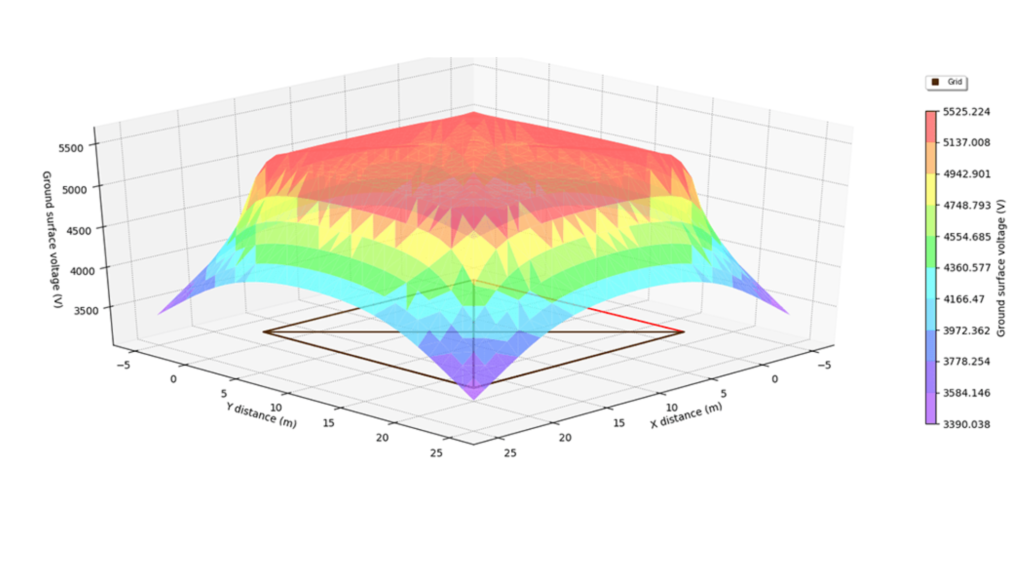
A well-engineered earth grid is the foundation of every safe electrical installation. In Australia, where fault currents can be enormous and site conditions range from wet coastal clay to bone-dry outback rock, getting earthing design right is one of the most technically demanding tasks in power engineering.
At GridServe, we design and model earth grids for substations, solar farms, BESS facilities, and transmission infrastructure across Australia — using state-of-the-art CDEGS software and a rigorous, standards-based approach. This article explains what earth grid design involves, why it matters, and what makes the Australian environment uniquely challenging.
What Is an Earth Grid?
An earth grid — also called an earthing system — is a network of buried conductors installed beneath and around an electrical installation. Its primary purpose is to provide a low-impedance path for fault current to flow safely into the ground during a fault event, and to limit dangerous voltages that could be experienced by people or equipment on or near the site.
During a fault, large currents flow through the earthing system into the surrounding soil. Without a properly designed grid, the resulting Earth Potential Rise (EPR) can create hazardous step and touch voltages across the site — endangering workers, the public, and connected infrastructure including telecommunications, pipelines, and fences.
Key Hazards an Earth Grid Must Control
Touch voltage — the voltage between a person’s hand and feet when touching an earthed structure during a fault. Step voltage — the voltage between a person’s two feet as they walk across the ground surface. Transfer voltage — EPR conducted along metallic paths such as cable screens, fences, or pipelines to locations outside the site. All three must be kept within safe limits defined by the applicable standard.
The Governing Standards in Australia
Earth grid design in Australia is governed by a layered framework of standards. Understanding which standard applies — and how they interact — is essential for compliance.
ENA EG-0 (2010)
Power System Earthing Guide — the primary management framework for earthing risk in Australian power networks. Sets the risk-based design philosophy adopted across all NEM participants.
ENA DOC 045 / EG-1
Substation Earthing Guide — detailed technical guidance for substation earth grid design, including conductor sizing, soil modelling, and step/touch voltage calculation methodology.
AS/NZS 2067:2016
Substations and high-voltage installations exceeding 1kV AC — the primary Australian Standard covering substation design including earthing system requirements.
IEEE Std 80-2013
"Guide for Safety in AC Substation Grounding" (the US title) — widely referenced across Australia as the technical basis for step and touch voltage calculations, explicitly recommended under the ENA earthing guides.
IEEE Std 2778-2020
"Solar power plant grounding" (US title) — dedicated standard for utility-scale solar farm earthing, increasingly required by network service providers for large renewable connections.
AS/NZS 3835.1:2006
EPR protection for telecommunications network users — governs the assessment and mitigation of hazardous voltage transfer onto telecommunications infrastructure within the EPR zone.
Network service providers such as Transgrid, ElectraNet, AusNet, Ergon Energy, and Evoenergy each publish their own earthing functional requirements that layer on top of these standards. Compliance with the NSP-specific document is a mandatory condition of grid connection.
The Earth Grid Design Process
A rigorous earth grid design follows a structured sequence of steps. Skipping or shortcutting any stage risks non-compliance, costly redesign, or — most seriously — a safety incident on site.
Step 1 — Soil Resistivity Survey
Soil electrical resistivity is the single most important input to any earth grid design. It is measured on site using the Wenner four-electrode method per IEEE Std 81, with probe separations scaled to the site dimensions. Multiple traverses across the site are required. Raw data is then processed using software such as CDEGS RESAP to derive a multi-layer soil model that accurately represents the real-world conditions at depth.
Step 2 — Fault Current Analysis
The maximum earth fault current and its duration determine the energy the earthing system must handle. This requires a fault current distribution analysis to determine what portion of the total fault current actually flows through the earth grid — accounting for current returned via overhead earth wires, cable screens, and neutral conductors. The grid current (also called the decrement factor-adjusted symmetrical fault current) is used as the design input.
Step 3 — Conductor Sizing
The maximum earth fault current and its duration determine the energy the earthing system must handle. This requires a fault current distribution analysis to determine what portion of the total fault current actually flows through the earth grid — accounting for current returned via overhead earth wires, cable screens, and neutral conductors. The grid current (also called the decrement factor-adjusted symmetrical fault current) is used as the design input.
Step 4 — Grid Layout and Modelling
The Earth Potential Rise of the grid is calculated and its zone of influence assessed. Any metallic infrastructure entering the EPR zone — including telecommunications cables, pipelines, fences, and LV neutral conductors — must be assessed for hazardous voltage transfer. Mitigation measures such as isolation transformers, NERs (Neutral Earthing Resistors), gradient control conductors, and optical fibre substitution may be required.
Step 5 — EPR and Transfer Voltage Assessment
The Earth Potential Rise of the grid is calculated and its zone of influence assessed. Any metallic infrastructure entering the EPR zone — including telecommunications cables, pipelines, fences, and LV neutral conductors — must be assessed for hazardous voltage transfer. Mitigation measures such as isolation transformers, NERs (Neutral Earthing Resistors), gradient control conductors, and optical fibre substitution may be required.
Step 6 — Testing and Verification
Once constructed, the earthing system must be tested to verify it meets design requirements. The fall-of-potential (FOP) method is used for standalone systems, while current injection testing is required for larger interconnected earth grids. Step and touch potential measurements are conducted at accessible locations across the site and compared to the design model predictions.
Australia's Unique Design Challenges
Australian conditions present some of the most demanding earthing design challenges found anywhere in the world. A solution that works in coastal Queensland will fail in the Pilbara. GridServe designs are always site-specific.
- High soil resistivity:Large parts of inland Australia feature extremely high resistivity soils — weathered granite, sandy desert, and dry laterite — with resistivities exceeding 1,000 Ω·m or even 10,000 Ω·m in the worst cases. This makes achieving a low grid resistance exceptionally difficult and often requires extended ground rods, chemical earthing electrodes, or remote earth systems.
- Multi-layer soil structures:Many Australian sites exhibit complex two- or three-layer soil profiles where a conductive upper layer overlies highly resistive bedrock. This can trap fault current in the upper layers and create elevated surface potentials even when the overall grid resistance appears acceptable.
- Seasonal variation:Soil resistivity in Australian climates can vary by 50% or more between wet and dry seasons. Designs must use worst-case (driest) conditions to ensure safety year-round.
- Remote and large-footprint sites:Utility-scale solar farms and BESS facilities often cover hundreds of hectares in remote locations. The earthing system must cover the entire site footprint, requiring extensive conductor runs, careful fault current distribution modelling across the array, and consideration of fences and metallic infrastructure spanning the full site boundary.
- Bushfire and corrosion environments:In bushfire-prone and coastal areas, conductor selection and burial methodology must account for accelerated corrosion, and above-ground earthing components must comply with bushfire attack level (BAL) requirements.
Earth Grid Design for Renewable Energy Sites
The rapid rollout of solar farms, wind farms, and BESS projects across Australia has created a large and growing demand for specialist earthing design. Renewable energy sites present several earthing challenges that differ from traditional substation design.
Solar Farms
Large site footprints require a distributed earthing system across the entire array. Panel mounting structures, combiner boxes, inverters, and the main substation must all be bonded into a unified earth system. IEEE Std 2778 provides dedicated guidance for solar farm earthing design.
BESS Facilities
Battery storage introduces unique earthing considerations including DC fault currents, the sensitivity of battery management systems to earth potential differences, and the need to manage hazardous voltage on battery enclosures and DC cable screens.
Wind Farms
Each turbine foundation forms part of the distributed earthing system, and the turbine steel tower must be integrated with the site-wide earth grid. IEC 62305-3 and IEEE Std 2870 govern wind farm earthing and lightning protection bonding.
Transmission Interconnects
New transmission lines connecting renewable projects to the grid introduce overhead earth wire (OHEW) and tower earthing requirements, affecting fault current distribution and the EPR at both the generation substation and connected network assets.
The Role of CDEGS Software
CDEGS (Current Distribution, Electromagnetic Fields, Grounding and Soil Structure Analysis) is the most comprehensive and widely accepted software platform for earth grid design and EPR analysis. GridServe uses CDEGS across all stages of the earthing design workflow.
RESAP
Processes raw Wenner-method soil resistivity measurements and derives accurate multi-layer soil models for use in grid design.
MALT
Models the earth grid conductor network and computes grid resistance, GPR, surface potential distribution, and step and touch voltages.
HIFREQ / FCDIST
Analyses fault current distribution in complex networks including overhead earth wires, cable screens, and multiple earthing points across transmission systems.
SESCAD
3D CAD environment for laying out conductor networks with precision — essential for large solar farm and substation earth grid modelling.
Few consultancies in Australia maintain active CDEGS licences and the depth of expertise needed to use all modules effectively. GridServe’s CDEGS capability is a genuine technical differentiator, enabling more accurate models, faster iteration, and higher confidence in design outcomes compared to simplified analytical methods.
Why a Compliant Earth Grid Matters
- It is a mandatory condition of grid connection — network service providers will not energise a substation without a certified earthing design and test report
- It protects workers and the public from electrocution during fault events — the legal duty of care under the Work Health and Safety Act is absolute
- It protects telecommunications, pipelines, and other third-party infrastructure from hazardous EPR transfer voltages
- An under-designed system that fails in service can result in asset damage, project shutdown, and significant legal liability
- Insurance and finance conditions for utility-scale renewable projects increasingly require demonstrated compliance with ENA EG-0 and the relevant NSP earthing standard
Need an Earth Grid Design or EPR Assessment?
GridServe delivers standards-compliant earthing design for substations, solar farms, BESS, and transmission infrastructure across Australia.
Contact GridServe
Whether you are at feasibility, detailed design, or approaching a hold-point test, GridServe can help you achieve a safe, compliant, and cost-effective earthing system. Contact us to discuss your project.
Written by
Anil Chaudhary
<div class="elementor-element elementor-element-0c15f3f elementor-widget elementor-widget-text-editor" data-id="0c15f3f" data-element_type="widget" data-e-type="widget" data-widget_type="text-editor.default"> <p class="team-bio">Anil Chaudhary is an experienced electrical engineer and energy infrastructure professional with extensive expertise in power systems, renewable energy, and battery energy storage systems. He combines strong technical capability with strategic leadership, having worked with major Australian utilities and infrastructure organisations across the design, engineering, and delivery of critical energy and telecommunications projects.</p><p class="team-bio">Anil has held senior leadership roles including General Manager at RSS CommTel, leading major infrastructure programs and operational teams. At GridServe, he leads engineering strategy, project delivery, and client partnerships.</p><div class="team-section-label">Key expertise</div><ul class="expertise-list"><li>Battery Energy Storage Systems (BESS)</li><li>Solar PV integration</li><li>Power system studies</li><li>Earthing system design</li><li>Lightning protection design</li><li>Grid compliance assessments</li><li>Engineering strategy & project delivery</li></ul> </div><h3 class="elementor-heading-title elementor-size-default">Past organisations </h3><div class="bio-bottom-list elementor-element elementor-element-d87ceed elementor-icon-list--layout-inline elementor-list-item-link-full_width elementor-widget elementor-widget-icon-list" data-id="d87ceed" data-element_type="widget" data-e-type="widget" data-widget_type="icon-list.default"> <ul class="elementor-icon-list-items elementor-inline-items"> <li class="elementor-icon-list-item elementor-inline-item"> <span class="elementor-icon-list-text">Power & Water Corporation</span> </li> <li class="elementor-icon-list-item elementor-inline-item"> <span class="elementor-icon-list-text">AusNet Services</span> </li> <li class="elementor-icon-list-item elementor-inline-item"> <span class="elementor-icon-list-text">Ausgrid</span> </li> <li class="elementor-icon-list-item elementor-inline-item"> <span class="elementor-icon-list-text">Telstra</span> </li> <li class="elementor-icon-list-item elementor-inline-item"> <span class="elementor-icon-list-text">RSS CommTel</span> </li> </ul> </div>
View all articles by Anil Chaudhary →