Arc flash is one of the most severe electrical hazards in the industry, and one of the most underestimated. It is possible to walk onto a site where every switchboard has a label, the safety management system references AS/NZS 4836, and the maintenance team genuinely believes they have it covered only to find when the numbers are run that the incident energy at the main switchboard exceeds 40 cal/cm². The PPE being issued to electricians may be rated for 8. That gap is the difference between a survivable burn and a fatality.
This article is a practical reference for electrical engineers, facility managers, EHS professionals, and project managers who want to understand what an arc flash risk assessment involves, what the legal obligations are in Australia, and what to look for when engaging a consultant to carry one out.
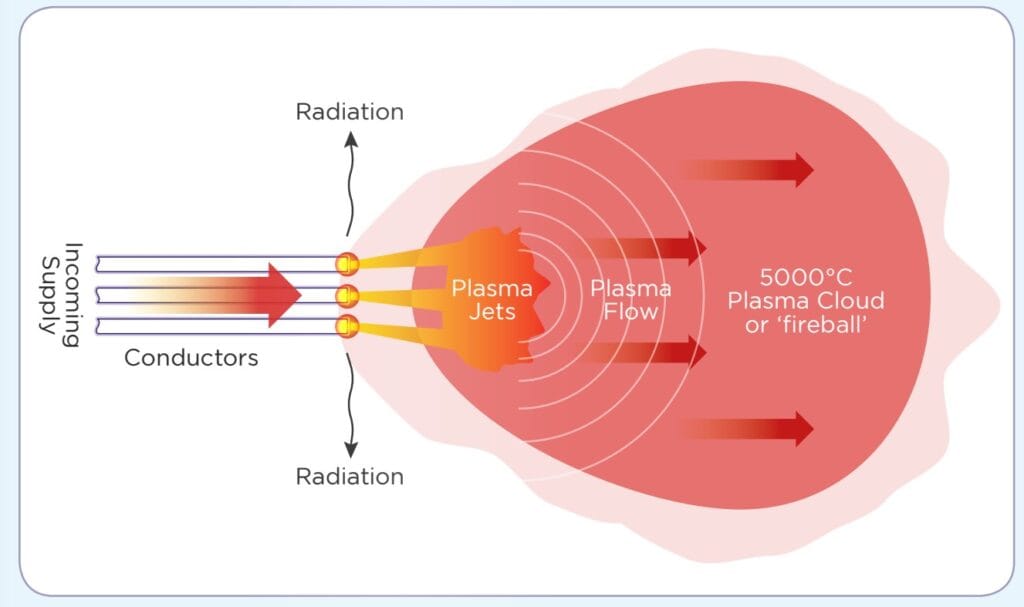
What Actually Happens in an Arc Flash An arc flash occurs when electrical current jumps through ionised air between conductors or to earth. The resulting plasma arc releases an enormous amount of energy in a very short time. Consequences can include third-degree burns across a large body surface area, pressure wave injuries, molten metal fragments projected at high velocity, UV radiation causing permanent vision damage, and ignition of surrounding materials and clothing. Most arc flash incidents happen on equipment the worker believed was de-energised or considered routine. The majority are preventable. |
1. Legal Obligations in Australia
Arc flash risk management in Australia sits across three overlapping frameworks: workplace health and safety law, electrical safety regulation, and engineering standards. Understanding all three is necessary to get a complete picture of what is expected.
1.1 The WHS Act and What It Requires
Under the Model Work Health and Safety Act – adopted across most Australian states and territories, with Victoria and Western Australia having equivalent legislation – a Person Conducting a Business or Undertaking (PCBU) has a primary duty to ensure, so far as is reasonably practicable, that workers and others are not exposed to health or safety risks. For electrical hazards, that duty is explicit and cannot be delegated.
The WHS Regulations require PCBUs to identify and assess electrical risks, eliminate or control them so far as is reasonably practicable, ensure affected workers are trained and equipped appropriately, and maintain safe systems of work for tasks involving live or potentially live electrical equipment.
In practice, the most defensible way to demonstrate that duty of care has been met is to have a documented arc flash study, completed by a competent engineer, that drives both equipment labelling and PPE selection. Without that, risk is being managed qualitatively at best.
1.2 State Electrical Safety Legislation
Each state and territory has its own Electrical Safety Acts and Regulations that sit on top of the WHS framework. State regulators including Energy Safe Victoria, SafeWork NSW, and the Electrical Safety Office in Queensland align their guidance with AS/NZS 4836 and the relevant Australian Standards. When a regulator investigates an arc flash incident, the first questions asked are whether a risk assessment was conducted and whether appropriate controls were in place.
1.3 Relevant Standards
| Standard | Relevance to Arc Flash |
| AS/NZS 4836:2011 | Safe working on or near low-voltage electrical installations. The primary Australian standard for managing electrical risk including arc flash at LV. |
| AS/NZS 3000:2018 | The Wiring Rules. Sets minimum design requirements that influence protection settings and fault clearing times, which feed directly into arc flash calculations. |
| AS 61439 series | Low-voltage switchgear and controlgear assemblies. Assembly ratings must be consistent with arc flash incident energy levels determined by the study. |
| IEEE 1584:2018 | Guide for Performing Arc Flash Hazard Calculations. The internationally recognised methodology for incident energy analysis. Widely used in Australia. |
| NFPA 70E:2021 | Standard for Electrical Safety in the Workplace. Referenced by many Australian consultants as the basis for PPE category selection and arc flash boundary definitions. |
| IEC 61641:2014 | Enclosed low-voltage switchgear. Sets arc flash containment requirements for switchboards — relevant when specifying new equipment. |
| AS/NZS 4491.1 | Safety of machinery. Relevant for arc flash risk on industrial machinery with high-energy electrical supply connections. |
Important Note on Standards Compliance Compliance with Australian Standards is not itself a legal requirement – they are not called up directly by legislation. However, they represent accepted engineering good practice, and a PCBU that has followed them is in a much stronger position to demonstrate that its duty of care was met. |
2. What is an Arc Flash Risk Assessment?
An arc flash risk assessment — also referred to as an arc flash hazard analysis or arc flash study — is a systematic engineering process that calculates the incident energy at specific locations throughout an electrical distribution system, determines the arc flash boundary at each location, and specifies the appropriate PPE level for workers performing tasks at those points.
2.1 What the Study Calculates
- Incident energy in cal/cm² — the thermal energy received at a defined working distance during an arc flash event of a given duration
- Arc flash boundary – the distance from the arc source at which a person without PPE would suffer a just-curable burn, defined at 1.2 cal/cm² or 5 J/cm²
- Required PPE arc rating or PPE category for each item of equipment
- Limited and restricted approach boundaries for unqualified persons and qualified electrical workers
- Engineering recommendations to reduce hazard levels where they are unacceptably high
Understanding Incident Energy – The Number That Drives PPE Selection Incident energy is expressed in calories per square centimetre (cal/cm²). It represents the thermal energy received at a set working distance during a worst-case arc flash event. For context: 1.2 cal/cm² is enough to cause a just-curable burn on unprotected skin. Arc flash events at main switchboards on typical industrial sites can produce incident energies of 20, 40, or well over 100 cal/cm² depending on system configuration and protection settings. PPE is selected to provide an arc thermal performance value (ATPV or Ebt) equal to or greater than the calculated incident energy. |
3. The Arc Flash Study Process
A well-executed arc flash study follows a structured engineering process. Here is how a typical study unfolds from first engagement through to equipment labelling.
| 1 | Data Collection and Site Survey Before any calculations can be done, an accurate picture of the electrical distribution system is needed -single line diagrams, utility supply data, transformer nameplate data, cable sizes and lengths, and protective device details. On most sites, documentation is incomplete or does not reflect what was actually installed. A physical site survey is nearly always required. This step is consistently underestimated in scope. |
| 2 | Power System Modelling Using verified site data, a model of the electrical distribution system is built in specialist software (ETAP is GridServe’s primary platform). The model runs a short circuit study — determining available fault current in kA at each bus and a protection coordination review, determining clearing time for each protective device. Fault clearing time is the single most important variable in arc flash incident energy. |
| 3 | Incident Energy Analysis With fault current levels and clearing times established, incident energy is calculated at each equipment location using the methodology in IEEE 1584:2018. Key inputs include available bolted fault current, system voltage, electrode configuration and conductor gap, working distance from the arc source, and the protective device clearing time at that arcing current level. |
| 4 | Arc Flash Boundary and PPE Determination Once incident energy is established, the study determines the arc flash boundary, the minimum arc-rated PPE required expressed as either a cal/cm² rating or a PPE category under NFPA 70E, and the approach boundaries for qualified and unqualified persons. These outputs are translated directly onto equipment labels. |
| 5 | Equipment Labelling Arc flash warning labels are produced for each item of equipment in scope. A compliant label shows the incident energy level and working distance, the arc flash boundary, the minimum PPE arc rating required, nominal system voltage, available fault current, and the date of the study. Labels are fixed to the exterior of each switchboard, MCC, or panel. |
| 6 | Report and Recommendations The final deliverable is a formal report documenting the methodology, system data, all calculation results, and engineering recommendations. Common improvements include adjusting protective device settings to reduce clearing times, installing zone-selective interlocking, replacing older fuses or breakers with current-limiting devices, and installing arc flash detection relay systems on high-energy equipment. |
4. When is a Study Required?
There is no single piece of Australian legislation that mandates an arc flash study in the same way as other compliance triggers. The obligation arises from the general duty of care under the WHS Act and the requirement to manage electrical risks. In practice, a study is required whenever the hazard exists and workers may be exposed to it.
| Trigger or Circumstance | Why a Study Is Required |
| New electrical installation or major upgrade | Baseline hazard levels need to be established before any live commissioning work begins. This should be scoped into the project from the start, not added at the end. |
| Change to network configuration or protection settings | Any change to upstream fault levels or protection clearing times can materially alter incident energy. Existing labels may no longer be accurate. |
| New generation or significant increase in fault current | Connecting solar, BESS, or a new utility supply changes fault levels throughout the distribution system. The whole study needs to be rerun. |
| Workers performing regular live electrical work | The study provides the quantitative basis for PPE selection and formal safe work procedures. Without it, PPE selection is a guess. |
| Following an arc flash incident or near miss | Regulators will expect to see evidence of a current, adequate risk assessment. |
| Regulatory audit or insurance requirement | Insurers and WHS regulators are increasingly requesting documented arc flash studies as a condition of cover or ongoing compliance. |
| Periodic review (at least every 5 years) | Electrical systems evolve over time. Equipment is replaced, configurations change, fault levels shift. Studies need to be refreshed to remain valid. |
| Contract or client requirement | Utilities, resources companies, and major infrastructure owners commonly require arc flash studies from contractors operating on their sites. |
5. Common Misconceptions
“Our switchboards are all labelled so we must be compliant”
Labels are only valid if they are based on a current, site-specific study using accurate system data. Generic labels that show a standard PPE category without a calculated incident energy figure, or labels produced before significant system changes, do not constitute compliance. A label that says ‘Cat 2 PPE required’ when the actual incident energy at that location is 35 cal/cm² is more dangerous than no label at all.
“We always de-energise before working, so arc flash is not our concern”
De-energisation is the most effective control available and should always be the first choice. However, tasks such as verifying de-energisation, live switching operations, testing under load, and thermographic inspection still require proximity to exposed live parts. The process of isolating and proving de-energisation itself involves arc flash exposure.
“We comply with AS/NZS 4836, which covers electrical safety”
AS/NZS 4836 is a good starting point for managing electrical risk, but it does not provide a methodology for calculating incident energy at specific equipment locations. A site that has implemented AS/NZS 4836 without a site-specific arc flash study has addressed the hazard qualitatively only. The two approaches are complementary, not interchangeable.
“We had a study done a few years ago and nothing has changed”
Things change on electrical systems more often than people realise. New transformers are installed, utility fault levels increase, protection settings get adjusted, additional generation is connected, and bus configurations change. Any of these can significantly alter incident energy levels. Studies should be refreshed at minimum every five years.
6. Who Should Conduct the Study?
An arc flash study is a specialist engineering task. It requires expertise in power system modelling, a solid understanding of protection systems and relay behaviour, proficiency in dedicated software, and familiarity with both the international standards methodology and Australian regulatory requirements. It is not a task for a generalist electrical contractor.
6.1 What to Look for in a Consultant
- Registered Professional Engineer or Chartered Electrical Engineer with power systems experience
- Demonstrated capability in protection coordination studies and power system modelling, not just arc flash in isolation
- Proficiency in recognised arc flash calculation software such as ETAP, SKM PowerTools, or EasyPower
- Working knowledge of IEEE 1584:2018 and NFPA 70E, and an understanding of the differences between the 2002 and 2018 editions
- Familiarity with Australian WHS legislation and state electrical safety regulatory requirements
- Experience conducting physical site surveys and reconciling as-built conditions with existing documentation
6.2 What a Thorough Study Should Deliver
| Deliverable | What to Expect |
| Scope and boundary definition | Clear agreement on which voltage levels, equipment items, and system areas are included in the study |
| Data collection plan | A structured list of information required from the client, including a site survey plan where records are unavailable or unreliable |
| Verified power system model | A model built in recognised software with short circuit and load flow results cross-checked against measured or utility-provided data |
| Short circuit study | Fault current levels at each bus, consistent with utility network data and the actual system configuration |
| Protection coordination review | Assessment of existing protection settings and clearing times, with TCC curves for all main protective devices |
| Incident energy analysis | Calculated incident energy in cal/cm² at each equipment location, using IEEE 1584:2018 methodology |
| Arc flash labels | Site-specific labels ready for installation, with all required information clearly presented and durable for the installation environment |
| Formal engineering report | Complete documentation of methodology, input data, results, assumptions, and limitations |
| Recommendations | Practical, prioritised recommendations to reduce hazard levels, with enough technical detail to implement them |
How GridServe Approaches Arc Flash Studies At GridServe, arc flash and protection coordination are treated as a single integrated discipline. An arc flash study will not be produced without reviewing the protection settings, because the two are inseparable. Fault clearing time is the primary lever available to reduce incident energy, and missing that opportunity means delivering a study that identifies the problem without helping to fix it. ETAP is used as the primary modelling platform and IEEE 1584:2018 is applied as the basis for all incident energy calculations. All studies are conducted by registered power systems engineers with hands-on site survey experience. Deliverables are designed to be used by the people who maintain and operate the facility — not filed in a drawer. Clear labels, practical recommendations, and a plain-language executive summary are standard. Contact: info@gridserve.com.au | 0499 178 078 | gridserve.com.au |
7. Summary
Arc flash is a serious hazard that exists on every site with exposed electrical equipment capable of delivering significant fault current. Managing it is a legal obligation under Australian WHS law and, more fundamentally, it is the right thing to do for the people who work on electrical infrastructure every day.
Key Takeaways
- A documented arc flash study is the clearest way for a PCBU to demonstrate that its duty of care for electrical hazards has been met. Without one, the risk is being managed on assumptions.
- Generic labels and qualitative assessments are not sufficient for sites with significant fault current exposure. A site-specific incident energy analysis using IEEE 1584:2018 is the appropriate standard of care.
- Protection coordination and arc flash cannot be separated. Reducing fault clearing times is the most effective and often most cost-effective way to reduce incident energy. A study that does not address protection settings is incomplete.
- Studies must reflect the current state of the system. Any material change to the electrical network requires a review. At minimum, studies should be refreshed every five years.
- Engage an engineer with specific expertise in power system modelling and protection. This is a specialist task and the quality of the work directly affects the safety of the people relying on it.
Get in Touch with GridServe GridServe Australia provides arc flash risk assessments, protection coordination studies, and power system engineering services to utilities, developers, EPCM firms, and asset owners across Australia. Whether you need a baseline study for a new facility, a review following system changes, or an integrated arc flash and protection coordination package, our team can help. Contact: info@gridserve.com.au | 0499 178 078 | gridserve.com.au |
Standards & References
| Standard | Description |
| AS/NZS 4836:2011 | Safe working on or near low-voltage electrical installations and equipment |
| IEEE 1584:2018 | Guide for Performing Arc Flash Hazard Calculations |
| NFPA 70E:2021 | Standard for Electrical Safety in the Workplace |
| AS/NZS 3000:2018 | Wiring Rules |
| AS 61439 series | Low-voltage switchgear and controlgear assemblies |
| IEC 61641:2014 | Enclosed low-voltage switchgear and controlgear assemblies — Guide for testing under conditions of arcing due to internal fault |
| Model WHS Act 2011 | Model Work Health and Safety Act (Cth) and corresponding state and territory legislation |
This article has been prepared by the GridServe Australia Engineering Team for general information and professional guidance purposes. It does not constitute legal or engineering advice. Site-specific arc flash studies must be conducted by a qualified electrical engineer in accordance with applicable standards and regulatory requirements. © 2026 GridServe Australia.
Written by
Anil Chaudhary
<div class="elementor-element elementor-element-0c15f3f elementor-widget elementor-widget-text-editor" data-id="0c15f3f" data-element_type="widget" data-e-type="widget" data-widget_type="text-editor.default"> <p class="team-bio">Anil Chaudhary is an experienced electrical engineer and energy infrastructure professional with extensive expertise in power systems, renewable energy, and battery energy storage systems. He combines strong technical capability with strategic leadership, having worked with major Australian utilities and infrastructure organisations across the design, engineering, and delivery of critical energy and telecommunications projects.</p><p class="team-bio">Anil has held senior leadership roles including General Manager at RSS CommTel, leading major infrastructure programs and operational teams. At GridServe, he leads engineering strategy, project delivery, and client partnerships.</p><div class="team-section-label">Key expertise</div><ul class="expertise-list"><li>Battery Energy Storage Systems (BESS)</li><li>Solar PV integration</li><li>Power system studies</li><li>Earthing system design</li><li>Lightning protection design</li><li>Grid compliance assessments</li><li>Engineering strategy & project delivery</li></ul> </div><h3 class="elementor-heading-title elementor-size-default">Past organisations </h3><div class="bio-bottom-list elementor-element elementor-element-d87ceed elementor-icon-list--layout-inline elementor-list-item-link-full_width elementor-widget elementor-widget-icon-list" data-id="d87ceed" data-element_type="widget" data-e-type="widget" data-widget_type="icon-list.default"> <ul class="elementor-icon-list-items elementor-inline-items"> <li class="elementor-icon-list-item elementor-inline-item"> <span class="elementor-icon-list-text">Power & Water Corporation</span> </li> <li class="elementor-icon-list-item elementor-inline-item"> <span class="elementor-icon-list-text">AusNet Services</span> </li> <li class="elementor-icon-list-item elementor-inline-item"> <span class="elementor-icon-list-text">Ausgrid</span> </li> <li class="elementor-icon-list-item elementor-inline-item"> <span class="elementor-icon-list-text">Telstra</span> </li> <li class="elementor-icon-list-item elementor-inline-item"> <span class="elementor-icon-list-text">RSS CommTel</span> </li> </ul> </div>
View all articles by Anil Chaudhary →